Descripción
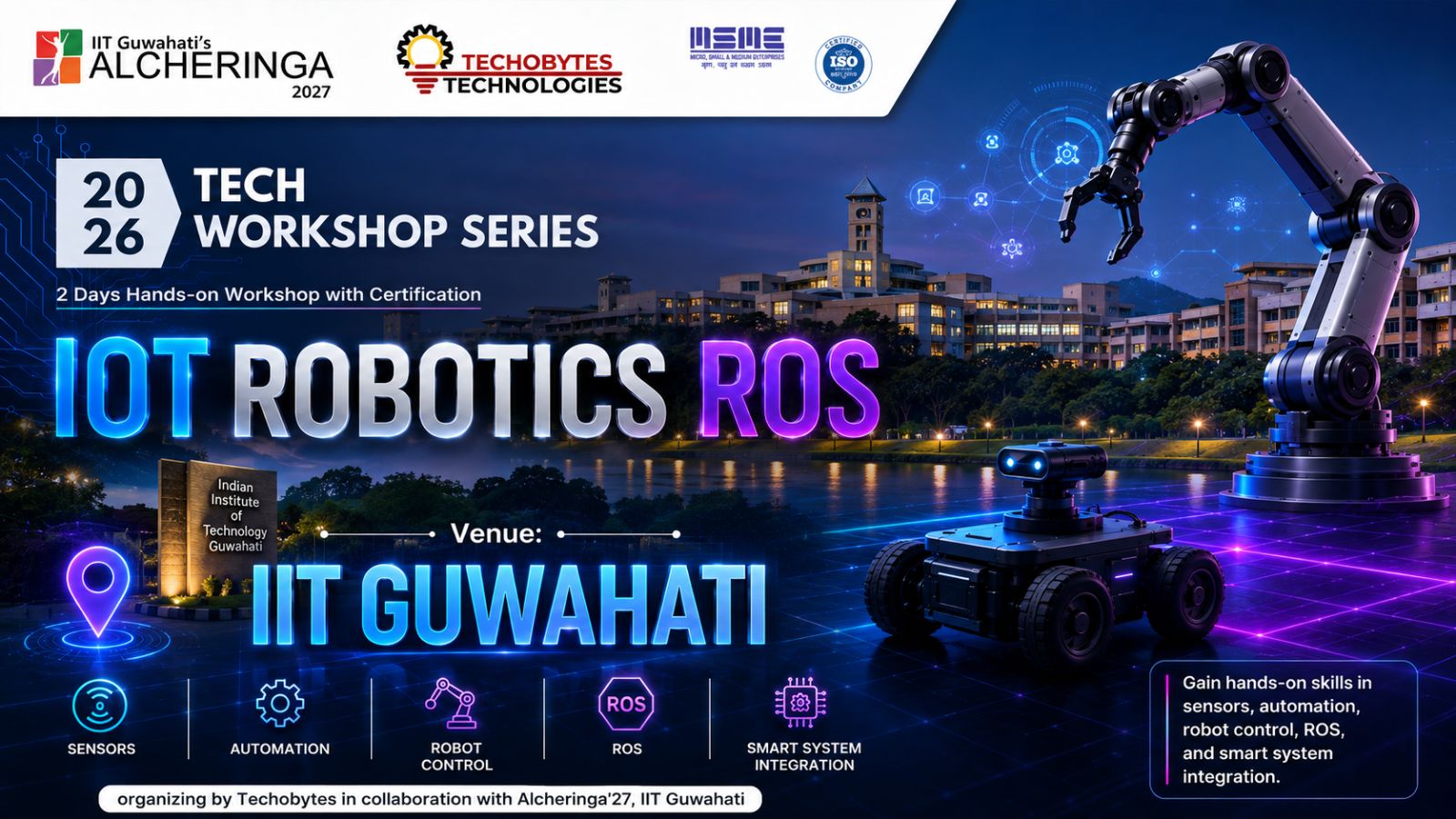
Tech Workshop Series 2026 with Globally Recognized Certification by Techobytes Technologies and Alcheringa'27 IIT Guwahati.Content will be covered from basic to advance level.AI-IOT-ROBOTICS-ROSDuration: 2 Days (14-16 HRS)Eligibility: Open to all, including B.Tech, B.E., undergraduate and postgraduate students, college students, school students, and anyone interested in AI, IoT, Robotics, and ROS.Workshop Objective & Final Project GoalBuild an AI-powered object-following robot that: - Uses ESP8266 for communication- Receives commands from a laptop- Uses IoT protocols for communication- Uses OpenCV + MediaPipe + YOLO for vision - Uses ROS for software architecture- Detects and follows an object- Avoids obstacles- Stops near the target objectDAY 1 – Electronics, Robot Building & IoTSession 1 : Introduction to Electronics & Embedded Systems Theory- What is a microcontroller?- Arduino architecture- Input vs Output- Digital signals- Sensors and actuators- Understanding voltage, current and GPIOActivity 1 : Digital Input & OutputPrograms:- LED Blink- Multiple LED patterns- Push Button Input- LED controlled using buttonLearning Outcome:- Understand Digital Read() - Understand Digital Write()Session 2 : Serial Communication Theory- What is UART?- Serial Monitor- Data transmission basicsActivity 2- Read user input from Serial Monitor- Control LEDs using serial commands - Create simple command interfaceLearning Outcome: Human-to-Microcontroller communicationSession 3 : Robot Building WorkshopHardware Assembly- Chassis assembly- Motor driver integration- Wheel mounting- Power connections- ESP8266/Arduino integrationActivity 3 : Robot Movement Programming Programs:- Forward- Backward- Left- Right - StopLearning Outcome:- Create a fully functional mobile robotSession 4 : IoT FundamentalsTheory- What is IoT?- Client-Server Architecture- Local vs Internet Communication - TCP vs UDPSession 5 : WiFi & Access Point ModeTheory- Station Mode- Access Point Mode - Network basicsActivity 4- Configure ESP8266 as Access Point - Connect laptop/mobileSession 6 : HTTP CommunicationTheory- Requests and Responses - GET and POST- REST ConceptsActivity 5- Send commands to ESP8266 using browser - Control robot through HTTPSession 7 : MQTT CommunicationTheory- Publish/Subscribe Model - Broker Architecture- Real-time communicationActivity 6- Publish messages- Subscribe to robot commands - Remote robot controlSession 8 : UDP Communication Theory- Low-latency communication- Use cases in roboticsActivity 7- Send movement commands using UDPDay 1 Deliverable Students will have:✓ Functional robot✓ Serial communication ✓ WiFi connectivity✓ HTTP control✓ MQTT control✓ UDP communicationDAY 2 – AI Vision & ROSSession 1 : Introduction to Computer Vision Theory- What is OpenCV?- Image processing basics- Camera fundamentalsSession 2 : OpenCV ActivitiesActivity 1- Webcam access - Image capture- Drawing shapes - Color detectionSession 3 : MediaPipeTheory- Landmark detection- Human pose estimationActivity 2- Hand tracking- Body tracking- Gesture recognitionSession 4 : YOLO Object DetectionTheory- AI Object Detection - Bounding boxes- Confidence scoresActivity 3- Detect everyday objects - Real-time object trackingROS FundamentalsSession 5 : ROS Overview Topics:- What is ROS?- Why ROS?- ROS Architecture- Nodes and communicationSession 6 : Environment SetupActivity- WSL Installation- ROS Installation- Workspace CreationLearning Outcome:- Create first ROS workspaceSession 7 : ROS TopicsTheory- Publisher- SubscriberActivity- Create Publisher Node- Create Subscriber Node - Exchange messagesSession 8 : ROS MessagesActivity- Standard Messages - Custom MessagesSession 9 : ROS ServicesTheory- Request/Response communicationActivity- Service Server- Service ClientSession 10 : ROS Launch FilesActivity- Create Launch Files- Start multiple nodes togetherSession 11 : Docker for ROSActivity- ROS Containers- Running ROS inside DockerFinal Project : AI-Powered Object Following Robot Components Used- ESP8266- Robot Chassis- OpenCV- MediaPipe- YOLO- ROS- MQTT/HTTP CommunicationProject Flow1. Camera captures video2. YOLO detects object3. ROS node processes detection4. ROS publishes movement commands5. IoT communication sends commands to ESP8266 6. Robot moves toward object7. Obstacle avoidance logic prevents collision8. Robot stops near targetDeliverables✓ Object detection✓ Object tracking✓ ROS communication✓ ESP8266 integration✓ Robot movement✓ Obstacle avoidance✓ End-to-end AI robotic systemWorkshop OutcomeBy the end of Day 2, students will have learned:- Electronics Fundamentals - Arduino Programming- Serial Communication- Robot Building- HTTP- MQTT- UDP- OpenCV- MediaPipe - YOLO- ROS Topics- ROS Services- ROS Messages- ROS Launch Files- Docker Basics- AI-Powered Robotics IntegrationFinal Achievement:Build a complete AI-enabled autonomous robot from scratch.