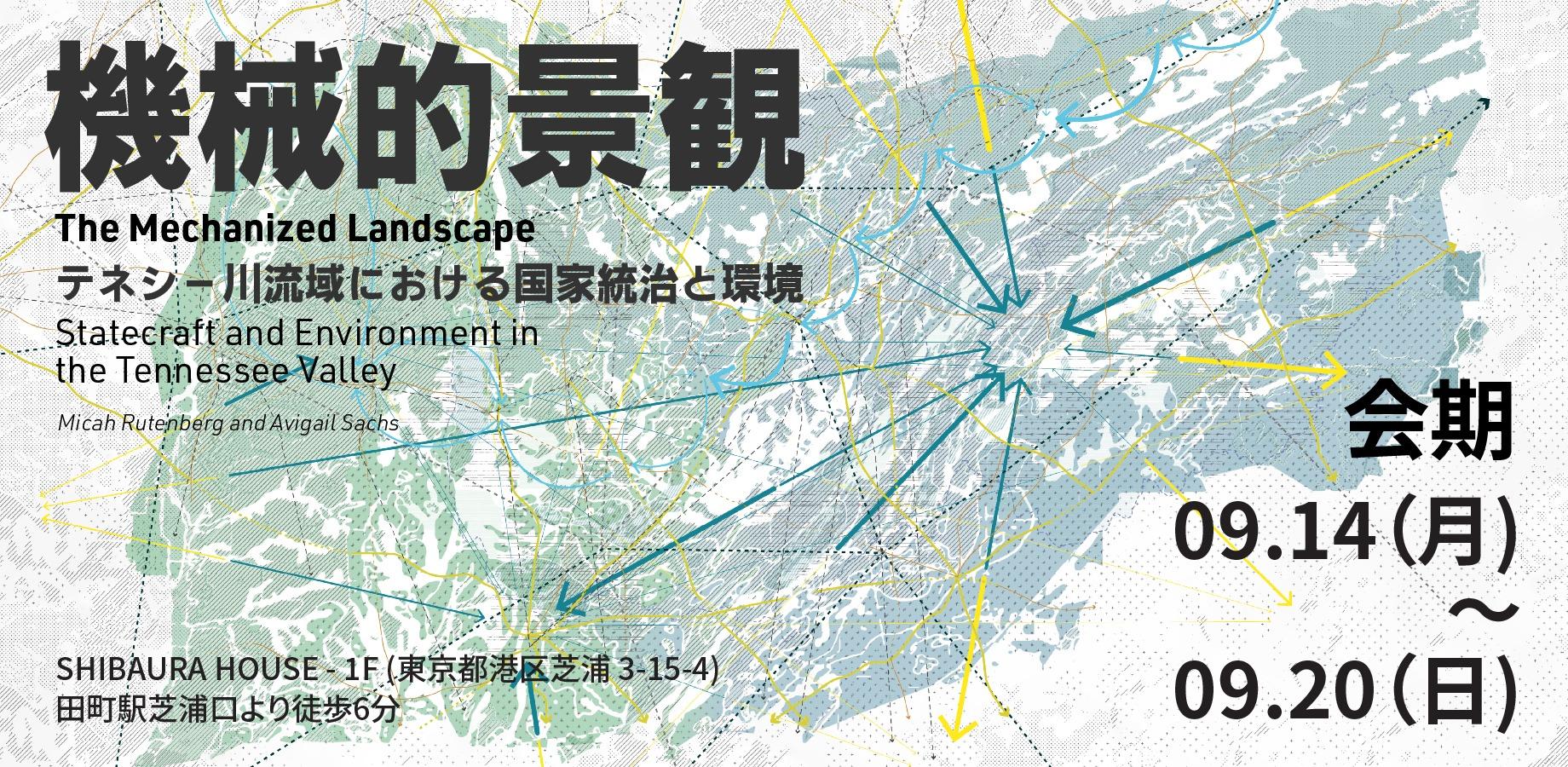
The Mechanized Landscape: Statecraft and Environment in the Tennessee Valley 機械的風景-テネシー川流域における国家統治と環境
Descripción
イベント詳細 Authors Micah Rutenberg and Avigail Sachs are pleased to present an exhibit and lecture on their recently published book, The Mechanized Landscape: Statecraft and Environment in the Tennessee Valley (Applied Research + Design Publishers, 2026). 書籍『機械的風景-テネシー川流域における国家統治と環境』(Applied Research + Design Publishers, 2026)に関する展示と著者マイカ・ルーテンバーグ(テネシー大学助教)とアヴィゲイル・サックス(同教授)によるトークイベント。 -- Exhibit schedule September 14 – 20, 11:00 – 16:00 展示スケジュール 9月14日 – 20日 11:00 – 16:00 Author’s talk and reception September 15, 18:00-21:00 Lecture begins at 19:00 (duration: 30-40 minutes) Presentation will be in English with Japanese translation. 著者によるトークとレセプション 9月15日、18:00-21:00 トークは19:00に始まります(30〜40分の英語のよるトーク、日本語通訳あり) Venue Shibaura House, 1F 3 Chome-15-4 Shibaura, Minato City, Tokyo 108-0023 〒108-0023 東京都港区芝浦3丁目15−4 Admission Admission Free (Limited to 50 participants. Reservation required) 料金 無料 (定員50名、要予約) Book purchases A limited number of books will be available for purchase at the reception. ¥5,500. Cash only. 書籍購入 展示の書籍をご購入いただけます。(部数小) ¥5,500(税込、お支払いは現金のみとなります。) -- Description In 1933, the United States government created a federal agency to oversee resource conservation, rural development, and agricultural improvement in the Tennessee River watershed, naming it the Tennessee Valley Authority (TVA). The watershed covers a vast area of the southeastern United States and includes parts of seven states. The scale of the TVA was unprecedented in American regional planning: it was the first time the federal government—rather than the states or the free market—took responsibility for human welfare in a single geographic region defined by its natural resources. By 1953, the TVA had achieved its goals by creating what we call a “mechanized landscape”—a seamless integration of engineering and environment. This transformation was carried out through three large-scale projects, or “machines.” The river machine focused on flood prevention and navigation; the land machine addressed forestry and soil conservation, and the power machine produced electricity for rural residents. This exhibit explores each facet of the Tennessee Valley’s “mechanized landscape” in two parallel investigations: mapping and photography. The maps present the elements of each machine, showing how they were integrated into the region, and highlight the spatial and temporal logic of each machine. The photographs were captured through physical immersion in the “mechanized landscape” and careful attention to specific places. They situate the visitor within a scene, highlighting the physical and spatial manifestations of the TVA project as it is experienced today. While the TVA is regionally specific, it has been a model for regional planning around the globe. Revisiting the TVA allows us to raise questions about the importance of regions, the complexity of the countryside, and how to take a holistic approach to the problems of rural societies. Seeing Japan through the TVA Though rooted in one region, the TVA became a model for regional planning worldwide—Japan included. From the Occupation era onward, the TVA approach was studied as a template for Japan's "comprehensive river development," informing the National Land Comprehensive Development Act (1950) and projects such as the Tadami, Kitakami, and Aichi Canal developments. Much of the logic of dams for flood control and power, and of rural electrification and modernization, traces back to this prototype. The exhibition's central question—who shapes the land, and by what logic?—is far from remote for a Japanese audience. In Japan, private railway companies as well as the state have designed entire ways of life along their lines, integrating housing, commerce, and culture. Read against Japan's own national development and private-railway management, the state-led TVA reveals infrastructure not as mere technology but as a means of organizing society while securing public consent—a form of statecraft. Shibaura itself, a landscape shaped by land reclamation and railways, offers a chance to reconsider the ground beneath our feet. テネシー川流域における資源保全、農村開発、そして農業改良を監督するため、合衆国政府は1933年に「テネシー川流域開発公社(テネシー・ヴァリー・オーソリティTVA)」という連邦機関を設立した。この流域はアメリカ南東部の広大な地域に及び、7つの州の一部を含んでいる。アメリカの地域計画の歴史において、TVAの試みは前例のない規模のものであった。自然資源によって定義された単一の地理的地域において、州政府や自由市場ではなく、連邦政府が人間の福祉に対して直接の責任を負ったのは、これが初めてのことであったからである。1953年までに、TVAは、工学(エンジニアリング)と環境がシームレスに統合された、いわゆる「機械的景観(mechanized landscape)」を創出することによってその目的を達成した。この環境の変貌は、3つの大規模なプロジェクト、すなわち3つの「マシーン(machines)」を通じて実行された。洪水調節と舟運に焦点を当てた「河川のマシーン(river machine)」、林業と土壌保全に取り組んだ「土地のマシーン(land machine)」、そして農村住民に電力を供給した「電力のマシーン(power machine)」である。 本展は、テネシー川流域における「機械的景観」のあらゆる側面を、「マッピング(地図化)」と「写真」という2つの平行したアプローチから検証する。地図は、それぞれのマシーンを構成する要素がどのように地域へ統合されていったかを示し、各マシーンが内包する空間的・時間的な論理を浮かび上がらせる。一方で写真は、「機械的景観」のただ中へと身体的に没入し、特定の場所に注意深く目を向けることによって撮影されたものである。これらの写真は、訪問者をその情景のなかに位置づけ、今日経験されるようなTVAプロジェクトの、物理的かつ空間的な顕現を浮き彫りにする。 TVAを通して日本を見る TVAは特定の地域に根ざした事業でありながら、戦後、世界各地の地域開発のモデルとなりました。日本も例外ではありません。占領期以降、TVA方式は日本の「河川総合開発」の手本として参照され、国土総合開発法(1950年)や、只見川・北上川・愛知用水などの総合開発計画の思想的な背景となりました。ダムによる治水と発電、農村の電化と近代化という発想の多くは、TVAという原型と地続きにあります。 「誰が、どのような論理で国土をかたちづくるのか」という本展の問いは、日本の観客にとっても決して遠いものではありません。日本では国家に加えて鉄道会社が、沿線の宅地・商業・文化までを一体的に設計し、生活そのものをデザインしてきました。国家主導のTVAと、日本の国土開発や私鉄経営とを重ね合わせるとき、インフラは単なる技術ではなく、人々の同意を得ながら社会を編成していく営み、一種の「統治」として立ち現れます。会場となる芝浦もまた埋立と鉄道が形づくってきた景観であり、本展を通して足もとの風景を問い直す機会となります。 -- Authors Micah Rutenberg Assistant Professor College of Architecture and Design University of Tennessee, Knoxville Mr. Rutenberg is an Assistant Professor of architecture and researcher who investigates how the design of large-scale infrastructure and technology shapes our understanding of geography and rural landscapes. He holds a Master of Architecture in Design Research from the University of Michigan, where he also received his undergraduate degree in architecture. He is a former Tennessee Architecture Fellow (2018), and has previously taught at Woodbury University in Los Angeles, California and Arizona State University in Tempe, Arizona. Avigail Sachs Professor, Associate Dean of Research College of Architecture and Design University of Tennessee, Knoxville Avigail Sachs teaches the history and theory of architecture and studies the design professions in the United States. She is especially interested in the relationship between design and research and the role of each in the formation of architectural practice. Her book Environmental Design: Architecture, Politics and Science in Postwar America, was published in 2018. Sachs is looking forward to implementing insights from this and related studies as Associate Dean for Research. Since moving to East Tennessee, Sachs has been fascinated by the history of the Tennessee Valley Authority, which was the subject of her 2023 book The Garden in the Machine: Planning and Democracy in the Tennessee Valley Authority. This study focused on the transformation of utopian ideals into professional practice in architecture, landscape architecture and regional planning. 著者紹介 マイカ・ルーテンバーグ テネシー大学建築デザイン学部助教授 大規模インフラの導入や技術設計が、地域の地理的構造および農村景観の変容に与える影響を多角的に検証する研究を行う。 ミシガン大学デザインリサーチ建築修士、同学建築学士。2018年テネシー建築フェロー、現職前はウッドベリー校、アリゾナ州立大学で教鞭を執る。 アヴィゲイル・サックス 建築デザイン学部 教授 兼 研究担当副学部長 専門は建築史および建築理論であり、主に米国におけるデザイン専門職を研究。デザインと研究の相互関係が、いかに建築の実践形成に寄与しているかに関心を持つ。2018年に戦後米国の建築と政治・科学の関わりを紐解いた『Environmental Design』を上梓。東テネシーへの移住後はテネシー・バレー・オーソリティ(TVA)の歴史に着目し、2023年にユートピア的理想が建築や地域計画へ変容するプロセスを追った『The Garden in the Machine』を出版した。これら研究から得た知見を、研究担当副学部長としての大学運営の実践に活かすことを目指している。 -- Please note that photos of the event will be taken for use in public relations, social media, etc. イベントの写真は広報やソーシャルメディアなどで使用するために撮影されますのでご注意ください。 This event is supported by the James Musgraves Research Award, College of Architecture and Design, University of Tennessee Knoxville.